The traditional head decoration used by the tribal and indigenous communities reveals a very rich expression of their social structure and political system. In this article, the colourful headgears worn by the communities inhabiting Manipur are being attempted to present from the fieldwork which was carried out by the author in the year 2013. The native communities of the state, numbering more than 34 ethnic communities have their distinct and socially sanctioned rules regarding the use of headgear and headdresses. It is strictly governed by the rules of the hierarchical social system, taboos, beliefs and practices deeply entwined to their socio-cultural life.
THANGAL TRIBE
Local Name: Pangrun (Males Headgear)
Tribe: Thangal Naga
Area: Senapati District, Manipur
Three different types of head gears used by the contemporary Thangal Naga tribe are explored, each of which has been distinctively identified with shapes and forms, use of colour patterns, and symbolic elements endorsed in gear.
THE COMMON MEN'S HEADGEAR (PANGRUN)
This headgear is acceptable to be used by Thangal Naga men regardless of their social status and class. It is primarily worn at the time of performing dance. Bamboo and woolen threads are used to make the headgear. It is distinguished from other headgears by the presence of seven vertically oriented bamboo splits, fitted between two layers of bamboo rings in the headgear. Woolen threads in vibrant shades of red, white, green, brown, yellow, black, and blue serve as decorative accents in this arrangement.
 |
| men's headgear |
Usually, the vertical spikes are painted in a checker pattern and occasionally in angular forms. The structure, form, and pattern of the headdress serve to identify it as a dance prop worn by regular male folks.WARRIOR'S HEADGEAR (PEE-PANGRUN)
 |
| warrior's headgear |
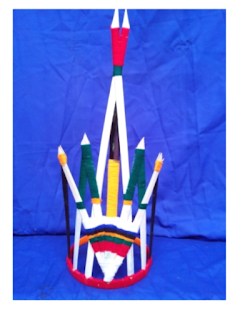
In the Thangal language, the warrior’s headgear is known as Pangrun or Pee- Pangrun. It is said that the color of the woolen threads used in this headgear reflects the quality of the wearer. It is necessary to have five vertical spikes at the front of the crown to represent the headgear of a warrior. The central spike represents the King and the others on the left and right represent the warriors who guard him. Another interpretation is that these five spikes represent the five fingers of the hand, which help us accomplish tasks quickly and effectively. The five projecting elements of the headgear thus symbolize a person's integrity, strength, and status.
TUKPAK (Headgear of a man of status)
 |
| Headgear for a man of status |
Tribe: Gangte
Area:Churachandpur, Manipur
Known as Tukpak in the Gangte language, the design of this traditional headgear is taken up from a prestigious gown used by the tribe as an important dress of ethnic identity. It is called Pondum. In the olden days, it was given as a reward to the brave and successful hunter by performing a rewarding ceremony called Haopha to honor the person for his bravery and successful hunting skills. Haopha is a community feast commemorated in celebration of a successful hunt. A pig from his possession is sacrificed in addition to the beast he had hunted. He is then honoured by felicitating a traditional shawl by the Cha-picha (clan head/ priest) and the chief will admire him by presenting the headgear in front of the villagers. Dances in appreciation of the person will be offered by the villagers. The reward thus attained will be kept with good care by the person in his home.
In this headgear, the number of branches symbolises prosperity. Each branch indicates the years of blessings. Five branches mean “ he is blessed that the coming years will encounter no ailments and suffering. He is blessed by his own people to live a prosperous life for the years to come. His family will have no scarcity of food and animal wealth and he will attain success at every level of his endeavor.
TUKPAK PUAN (Turban cloth for Male)
Tribe: Gangte
 |
| Turban for male |
Area: Churachandpur, ManipurMen wear this woven fabric as a turban. In addition to ornamented headgear, the ordinary man often uses woven clothing with stripped designs as a headpiece worn during festivals and significant social occasions.
LEIPUI
Headgear for unmarried girls
Tribe: Chothe
Area: Lamlanghupi Chothe Village, Bishnupur, Manipur
 |
| Leipui |
This traditional headdress is worn by unmarried girls while
dancing at important events such as Yu-hongba (a ceremonial brew of local
liquor), Pham Kaba (taking office by a socially dignified person), Ura-hongba
(a ritual), Yum-hongba (an event marking the opening of a home), Khongnang
hongba (a ceremony involving the divination of an old banyan tree), and
numerous other festivals associated with the agricultural cycle.
 |
Chothe Man with
his turban Lujei |
It is prepared by a thickly splinted bamboo headband
containing spikes extending vertically from the band's
circle. It has geometric designs and embellishments made with woolen threads.
Rooster feathers are used to adorn the tip of these spikes. The diamond-shaped
patterns raised in three progressive layers in distinct colours are said to have
been taken from the woven motifs of a turban known as Lujei.
 |
| Ornamented bamboo spikes |
According to a native Chothe craftsman Kundo
Chothe, ‘the projected vertical element should essentially be adorned with four
spikes to balance the beauty of headgear as it is only meant to be worn by the
young lass. Married women should refrain from wearing this headgear as it
symbolises the glorious youthful days of unmarried girls. The headgear is indispensably
worn during the performance of Shirou Lam dance in festivals and ceremonies. to be continued...


Comments