RUSHEM: A MUSICAL INSTRUMENT

Rushem: a traditional wind instrument
Rushem being an important accompaniment of song and dance is played in every festive and ceremonial ocassions among the Kom people and other Kuki-Chin tribal groups of Manipur. It is a wind instrument prepared by master craftsman in a local fashion by using locally available materials like bamboo, dry gourd, bee-wax, powder of conch-shell and feather of Cock.
Bitter-gourd ready to harvest
for preparing shell  of Rushem

Scrapping the upper layer (skin) of the newly harvested gourd

Keeping dry-gourd
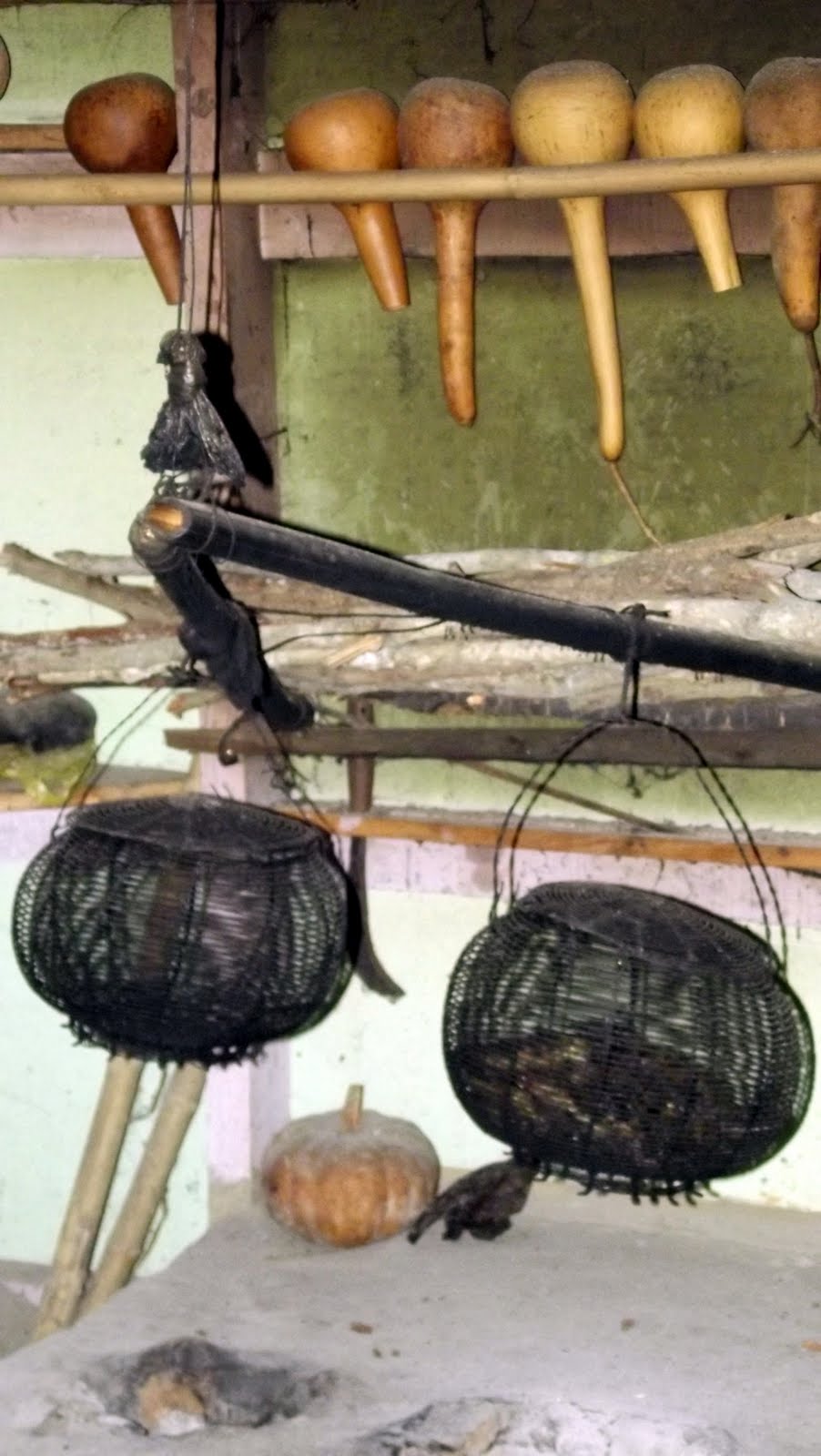
above the hearth for fumigation

Process of seasoning bamboo pipes by placing on the
hanging platform above the fire place to achieve constant
fumigation


Segmented and complete view of Rushem

November and December is the right time to collect fine props of bamboo to be used as wind pipes of different sizes to be passed inside the body of a gourd from six different holes to produce different tunes in a defined note and scale. Interesting part of Rushem is the appropriate use of a bitter-gourd/ bottle gourd shell (Langenaria siceraria) as resonator. 
The bitter gourd either wild or planted in the surrounding field or homestead land is given appropriate care and protection from any kind of unwanted damages or loss until it is collected. It is harvested when the lower part of the body turns brown in colour. The upper layer (skin) of the gourds selected for the preparation of Rushem are scrapped with sharp knife and it is exposed to sun for few days. Further for seasoning, it is kept above the hanging platform of fireplace (hearth) to get constantly fumigated. This traditional method of preservation is applied to prevent from unwanted attack of insects and termites. Similarly, small bamboo props/ reeds are also seasoned to utilise at the time of preparing Rushem. 

Parts of Rushem


Fig: Parts of Rushem

Bottle-gourd showing six holes and metal buzzers

Rushem consists of a resonating body prepared from shell of bottle gourd. It is six reeds of bamboo with buzzers (Rushem Jang) made from thin plate of brass fixed uniformly in each of these wind pipe by inserting into the holes as arrayed in the figure illustrated above. The upper holes contain three large size Kache (bamboo reeds/ wind pipe) while other three are fitted in specified order just below the upper holes. While fitting these wind pipe bee-wax is used to conceal the holes tightly. Each of these Kache bears holes called Khor to play different tunes and notes. A bellow (Atumna), made of bamboo pipe is inserted from the mouth of the gourd. This bellow contains a notch near the bottom called Athi Supna for supplying wind uniformly into the shell to resonate from the vibrating sound of the buzzer. The buzzer being the most important part of Rushem, creates desirable sounds and notes. It is meaningfully represented by the name Rushem Jung which literary means the root/ genital of Rushem. According to a folk belief, 'Rushem Jung is the divine representation of father -the creator while womb-shaped body represents the divine mother. The divine union creates the most enchanting and beautiful sound of Rushem'.
Textile motif showing Rushem Jung (in colour)
Rushem Jung as an important textile motif are also found in the woven designs of prestigious gowns and ceremonial shawl of the tribe which are especially worn by the chieftain and noble family during special social events.

Rushem Jang (brass made buzzer) feather of Cock
and paste obtained  from the Conch shell by rubbing on stone
used at the time of preparing buzzing wind pipe.
Rushem Jung as a buzzer is prepared from thin plate of brass rectangular in shape. It contains a trigger in the middle that vibrates through the wind blown by the player from the bellow. The trigger of the plate is sharpened and prepared very thin unless appropriate sound is attained. When desirable sound and note from the buzzer is attained, it is fitted into the wind pipe and sealed with paste prepared from the powder of conch shell obtained by rubbing on stone. According to traditional Kom belief, 'preparation of Rushem must undergo with ceremonial conduct. The person has to perform sanctification rites with the help of priest before it is prepared.
Now a days, only a few elderly persons from Kom villages know this age-old craft of preparing Rushem. This traditional folk instrument having accumulated with native cultural elements, provide valuable information to peep into the socio-cultural and religious life of the Kom tribe.

* based on the field documentation held at Khoirentak Khuman, Kom Village, Manipur

Comments

Unknown said…
Dear Sagmacha Nongmaithem,

I Belong to Thadou Tribe,largest single majority Tribe in manipur as per 2011 Census. The musical instrument you Highlight belongs to a Thadou-Kuki Tribe. The said instrument is spelled as "Goshem" but not "Rushem".

Goshem is a combination of two words in Thadou Dialect. "Go meaning Bamboo" and "Shem meaning Blow".

I therefore kindly request you to replace Rushem as Goshem.

Thanx in antipation!
Maro@Xing said…
This instrument is indigenous to Kuki-Chin groups of people and does not solely belong to Thadou tribe. Rushem is the same meaning as Goshem/Gosem used by Kom people. Thadou people are not the only ones who used this indigenous instrument. Mr. Michael, may you explore more about our sister tribes and find the common things. Please do not claim saipikup as solely belonging to Thadou tribes, Kom people used it too.
Seikholen Kuki said…
The people call gosem as Rushem which has the same meaning. They are also from among the Kuki tribes. We are all in Kukis. There are so many sub tribes in Kuki too.

Popular posts from this blog

Longpi Pottery of Manipur

HAMPAI Large size traditional vessel used by the socially dignified person for giving feast. Longpi village is located 40 Kms away from the Ukhrul district head quarter of Manipur. Majority of the villagers are potters who prepare handmade pots and household earthen ware as an important occupation in addition to their agricultural works. This age old skill of handmade pottery is inherited from their forefathers. Longpi Pot of Manipur has been able to attract large number of people from both the domestic and international arena. It is known not only for its unique shapes and innovated designs but also for the beautiful texture and metal like appearance normally used in various household functions either as kitchen utensils or decorative items for the fancy people. Traditionally, Longpi potter used to prepare Hampai (pot of a dignified man) for the noble family and a man of social status other than the common household utensils. Hampais were used in massive food preparation during s...

PHIRUK: A CEREMONIAL BASKET OF MANIPUR

Phiruk/Phingaruk/Phinairuk and Tabu are the special the special kinds of storage baskets used in Manipur. The Meitei use it as an indispensable item for marriage ceremony.  The Maring tribe of Manipur are specialised in this traditional craft. They have got mastery over the production of this beautiful designs which they attain by using naturally dyed fine splits of bamboo. According to a local version, 'Phingairuk (Phingang; red cloth, luk- basket) is named after a group of Maring tribe who used to wear red-bordered cloth. Woven by the hill tribe, it is indespensably used by the Meiteis to commemorate the rituals and ceremonies of marriage functions. This age-old basket undoubtedly narrates the cultural history of harmonious social relation with the people of the hills and plains. Phiruk (Phi - cloth, luk/ruk - basket)/ Phinairuk or Phingaruk is a ceremonial basket available in two different sizes. The large one is used in the worship of the family and village deities and al...