Museum Curators adopt many of the display options to mount objects for curating exhibitions. Items like mannequins, armatures brackets and hanging elements are used for displaying objects in a sensible way to protect the collections from unwanted damages that are liable to cause mostly by an impractical way of exposition and presentation. Mannequins have been an important item used in the display of textile collections especially the cloths and garments. From the tailoring works of the royal guild to the space of Museum display; from the merchandised shops to the modern fashion industries, Mannequins have been used as an important component for exhibiting garments. The modern Show rooms of garments exhibit different collections of fashionable fabrics to attract the customers.
The early forms of Mannequins prepared by wood, wax, papier-mâché and heavy fabric took an arduous level of workmanship to sustain the level of balance keeping the structure to an upright position. These are now replaced with stereotypical models prepared with different kinds of material compositions that are light-weight and durable to use. However, the Mannequins used in the Museum displays are designed to the context of its theme of exhibition and presentation. The curator has to bear in mind about the authenticity of the exhibit and its presentation should not lose the aesthetic values and cultural context of the object. A decent way of displaying the objects (garments or cloths) on mannequin makes an exhibit very professional and appealing to the visitors. Almost all the Museums in the world use professionally designed forms of Mannequins as an important tool for mounting exhibitions. Dioramas, showcases, Panels and Pedestals are some of the important components of Museum display.
In the recent past, many of such display have come up with certain innovations and creative ideas to make the exhibitions more interactive, participatory and visitors friendly. Curating Exhibitions in the Ethnographic Museums with an active participation of the concern communities make more sensible. Exhibitions which are created with the participation of the concern community not only enhance the level of display but also help the Museum to gratify the result in larger interest of the people.
As a person belonging to the Museum profession, here I am with a community who come up with a strong desire to exhibit and present their material cultural items displayed in their own perception. The traditional garments displayed in the Mannequin without the use of body and face is desired by them to be exhibited with proper representation of human forms. They wanted to display it to a human form which their traditional craftsman/ sculpture artists can prepare. It is with the above idea that the traditional sculptor and doll maker from the community being invited to conduct a workshop on sculpting the community prescribed forms of Mannequin or human forms. This artwork according to them is inspired by their age old tradition of doll making called Laidhee Shaba and Mi Tamba. Under the patron of the Maharaja of Manipur, the art of sculpting flourished in Manipur through the royal guild. Mi Tamba literally can be translated as the creation of human figure from the shadow. Mi stands for shadow and Tamba means to learn or to create in Meitei dialect of Manipur. According to the myth of creation the Taibang Panba Mapu (the creator) in the heavenly world had asked his successor to create life on the earth created by him. Following the command of the supreme God, life were created on this earth to live and those were the Snake, Frog, fish and the Monkey. Almighty was not satisfied with these creations, he further had asked to create humans which they could not. Finally, the Taibang Panba Mapu had to intervene by casting his shadow in front of them. It was the shadow of the Creator that the human beings on earth was created.
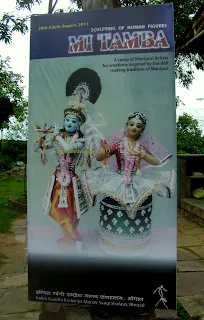
Inspired by the doll making tradition of Manipur, MI TAMBA is an innovated form of art work or sculpture flourishing in Manipur. The traditional doll is popularly known as Laidhee and the toys like Sagol-Samu (animal figures prepared from the powdered-paste of rice) were given not to entertain their kids to play but also to supplement the requirement of food for the children with this edible toys. Children used to play with these toys in leisure even in the absence of their parents when they feel hungry, these were eaten up as an item food. In the recent past, doll making tradition emerges with a lot of innovations. Although, there has been a great deal of changes in the material composition, forms and structures, these artwork continue to retain the aesthetic appeal, charm and expressions. This perhaps is one of the reason that Manipuri dolls still able to captivate the attention of larger people even after the intrusion of sophesticated and stereotypical forms of modern dolls and toys in the famous IMA KEITHEL (traditional market of women in Manipur).
The Workshop is committed to prepare traditional sculpture of male and female bodies representing the legendary Khamba and Thoibi, Jugal Murti of Radha and Krishna, and a drummer playing traditional Meitei Pung (drum). The days work of sculpting the forms by using raw materials like straw, cloth, clay, jute, Kapur, gunny cloth, Maida paste, iron rods etc.
will be visually presented here till the completion of mannequins for display.
DAY 1
 |
Offerings made before the
commencement of Sculpting workshop |
 |
| Kneading of clay mixing with small pieces of Jute |
 |
| Shaping facial structure to prepare mould |


Comments
THANK YOU AND APPRECIATE YOUR EN DEVOUR TO MAKE THE THING IN RIGHT DIRECTION.
NILANJAN KHATUA